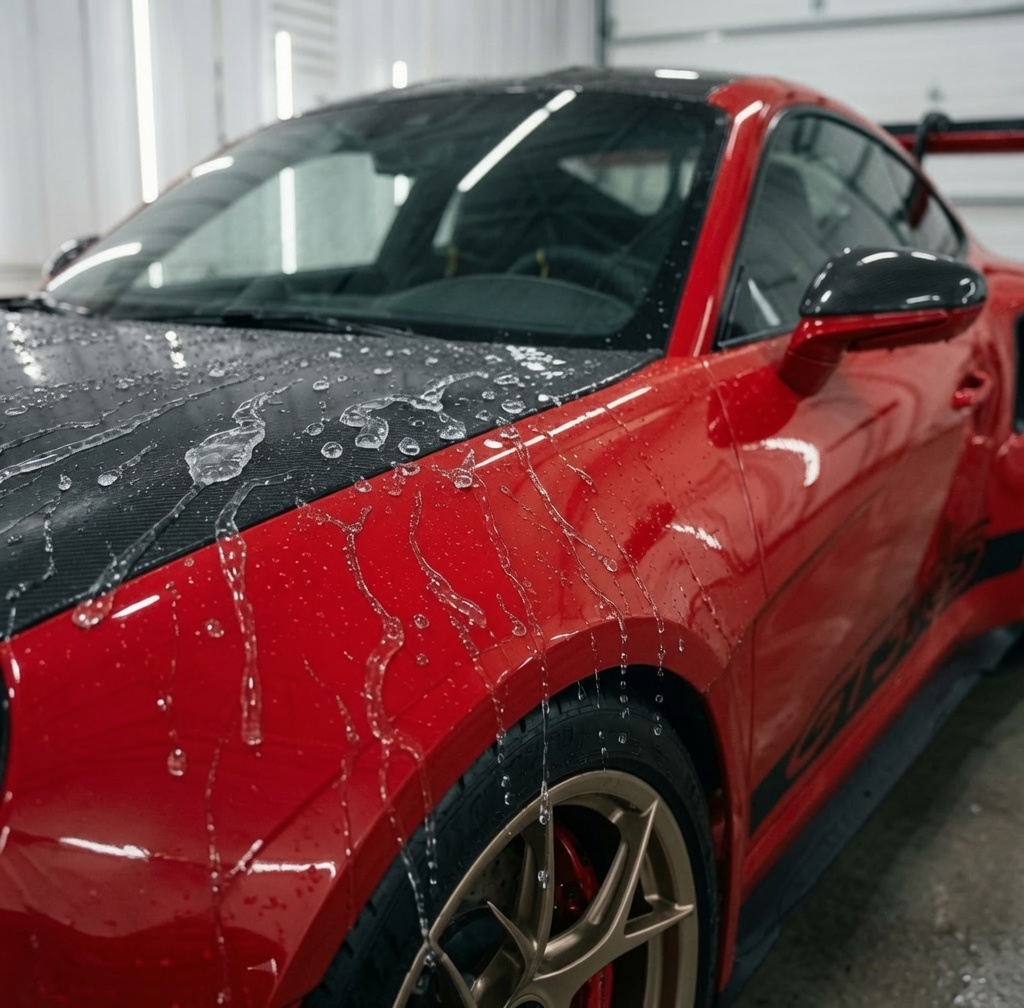
Ceramic Coating in Richmond, BC: Real Benefits vs. the Cheap Spray-On Trap (Gyeon System)
"You don't polish a car once. You protect it, so you never have to polish it that hard again."
- Larry Kosilla
What Ceramic Coating Actually Does, and Why the $99 Version Isn't the Same Product.
If you've searched "ceramic coating near me" in Richmond or anywhere in Metro Vancouver, you've probably noticed the price range is enormous. Some shops quote $150. Some quote $2,000+. Both call it "ceramic coating." Both are technically telling the truth.
That's the problem. The term has been stretched so thin that it now covers everything from a proper 9H-hard silica-based coating chemically bonded to corrected paint, to a bottle of spray sealant a car wash upsells you on while you're waiting for your vacuum slot.
We see the aftermath of the cheap version constantly. Customers come in with a car that was "ceramic coated" three months ago, water isn't beading anymore, the swirl marks under the coating are still there (because they were never removed, just sealed in), and they're paying us to fix it properly.
So let's actually break down what ceramic coating does, why it matters more here than almost anywhere else in Canada, and what separates a real install, using the Gyeon Q² system we run in-shop, from the quick version.
What Is Ceramic Coating, Actually?
Ceramic coating is a liquid polymer, usually silica dioxide (SiO2) or, in the case of Gyeon's current-generation products, modified polysilazane based, that chemically bonds to your car's clear coat rather than sitting on top of it like wax. Once cured, it forms a hard, glass-like layer that becomes part of the paint's surface. Unlike wax, which breaks down within weeks, a properly applied ceramic coating is designed to last years, not months.
That bonding is the whole point. Wax and traditional sealants are sacrificial. They sit on the surface and wear away, which is why you have to reapply every 4-8 weeks. A ceramic coating cures into a semi-permanent layer, which is why it holds up for years on a properly maintained vehicle rather than weeks.
At Element Auto Spa, we're a Gyeon-partnered shop, which means we're not mixing whatever's cheapest that week. We run Gyeon's Q² EVO lineup across the whole car, one dedicated coating engineered for each surface, rather than a single generic bottle sprayed on everything from your wheels to your dash.
The Real Benefits of Ceramic Coating

1. UV Protection That Actually Slows Down Fading and Oxidation
Paint fades because UV radiation breaks down the resin in your clear coat over time, causing oxidation, dullness, and eventually that chalky look you see on neglected older cars. A ceramic coating adds a UV-resistant layer on top of the clear coat that absorbs and reflects a significant amount of that radiation before it reaches the paint. On a car that sits outside through the long summer daylight hours, it's the difference between a clear coat that still looks wet in five years and one that's starting to haze.
For paint specifically, we apply Gyeon Q² Mohs EVO, named for the Mohs hardness scale used to rate mineral hardness. It's built from modified polysilazanes (a chemistry that's fairly new to car care), which increases surface hardness, slickness, and UV resistance beyond older SiO2 formulas, while curing into a coating Gyeon rates for up to 36 months or 40,000 km on a single layer, and up to 48 months or 50,000 km with two layers.

2. Hydrophobic Beading That Makes Rain Work For You Instead of Against You
This is the one everyone's seen in the videos: water hits the hood and just balls up and rolls off instead of sheeting across the surface. That's not a party trick. Water that beads and sheets off takes dirt, road grime, and pollutants with it, which means less contact time for corrosive material to sit on your paint. In a city where it rains more days than it doesn't for half the year, that self-cleaning effect does real work between washes, and it's one of the built-in properties of Mohs EVO on paint.
3. A Genuine (If Limited) Layer of Scratch and Swirl Resistance
Ceramic coating will not stop a rock chip or a keying. Anyone who tells you it will is selling you some BS. What it does is add measurable hardness to the surface, which helps resist the light marring and fine swirl marks caused by wash mitts, dust, and everyday contact. Less swirling means your paint holds its correction and its gloss for longer between details.
4. Chemical Resistance Against the Stuff That Actually Etches Paint
Bird droppings, tree sap, bug guts, and industrial fallout are acidic. Left on unprotected clear coat, they can etch in within hours, especially in direct sun. A ceramic coating creates a barrier that gives you a much longer window to notice and wash it off before it bonds to the paint. If you park under trees near the dyke trails or anywhere near the Fraser River flight path from YVR, this one matters more than people expect.
5. Road Salt and Brake Dust Protection Through the Wet Season, Including Your Wheels
This is the one that's specific to us. From November through March, municipal crews and highway maintenance run brine and salt across Highway 99, the Oak Street Bridge, and every arterial into Richmond. That salt doesn't just sit on your paint, it clings, especially combined with the near-constant wet weather.
It's also brutal on wheels, which take the added abuse of brake dust baked on by heat, on top of the salt. That's why wheels get their own dedicated product in our system rather than a leftover pass with the paint coating. We use Gyeon Q² Rim EVO, formulated specifically for rims rather than repurposed paint coating, rated to withstand temperatures above 800°C without breaking down (relevant given how hot rotors and calipers get) and to significantly cut brake dust adhesion, so wheels rinse clean instead of needing an acid wheel cleaner every wash. Gyeon rates Rim EVO for up to 18 months or 45,000 km, and it's designed to leave a neutral, factory-look finish rather than an artificial gloss.
6. Dramatically Easier Maintenance Washing
Because contaminants don't bond to the surface the same way, a coated car needs less scrubbing, fewer harsh chemicals, and less time at the wash. That's not just convenience, it's fewer opportunities to introduce swirl marks from dragging a dirty mitt across the paint. A coated car that gets a gentle two-bucket wash every couple of weeks will hold its gloss longer than an uncoated car that gets scrubbed hard once a month.
7. Enhanced Gloss and Depth
A quality ceramic coating adds optical clarity and gloss on top of correctly polished paint. This is why we insist on paint correction first: the coating amplifies whatever is underneath it. Correct the paint, then coat it, and you get that "wet look" depth. Coat over swirls and oxidation, and you get a glossy layer sitting on top of visibly damaged paint, permanently.
8. Long-Term Resale Value Protection
A car with a documented, professionally maintained ceramic coating history typically shows less visible wear, fewer swirl marks, and a clear coat closer to factory condition at resale. In a market like Richmond and Greater Vancouver, where import and luxury vehicle turnover is high and buyers are detail-savvy, that difference shows up in both the asking price and how fast the car sells.
It's Not Just Paint: A Full-Vehicle Protection System
This is where a lot of "ceramic coating" packages fall short. Paint gets all the attention, and everything else on the car (glass, wheels, PPF, leather) either gets skipped or gets hit with the same generic paint coating repurposed for a job it wasn't built for. We run a dedicated Gyeon product for each surface (except for glass), because glass, wheels, film, and leather all fail in different ways and need different chemistry.
Paint: Gyeon Q² Mohs EVO. Covered above. Applied after full decontamination and paint correction, cured into the clear coat for years of hardness, gloss, and UV resistance.
Wheels: Gyeon Q² Rim EVO. A dedicated wheel coating rather than a generic ceramic sprayed on rims as an afterthought. It's rated above 800°C, cuts brake dust bonding, and holds up to 18 months / 45,000 km, which matters on a car that's braking constantly on Vancouver's stop-and-go roads.
PPF (paint protection film): Gyeon Q² PPF EVO. If your car has PPF, the film itself still needs protecting from staining, yellowing, and UV breakdown. PPF EVO is formulated specifically for modern film (glossy, satin, or matte, including stealth finishes), rated for up to 24 months / 25,000 km, and it won't alter the film's finish or flexibility. It's the same logic we walk clients through on our PPF installs: the film protects the paint, and the coating protects the film.
Glass: Griot's Garage Ceramic Glass Coating. Windshields and side glass get their own SiO2-based coating rather than the paint product, because glass needs a different bond and, frankly, better visibility in the rain is a genuine safety feature, not just a nice-to-have. Water sheets off at highway speed instead of smearing under your wipers, and the coating also keeps road film, bugs, and pollen from bonding to the glass in the first place.
Interior leather: Gyeon Q² LeatherShield EVO. The interior takes just as much abuse as the exterior, UV through the windshield, dye transfer from jeans, spilled coffee, everyday wear. LeatherShield EVO is built for modern automotive leather, adds anti-stain and dirt-repellent protection, and holds up to 18 months / 30,000 km without changing the leather's look, colour, or feel.
Put together, that's five coatings engineered for five different surfaces instead of one bottle stretched across a whole car. That's also why a full system costs more than a $150 wipe-on special, and why it protects like it.
Professional Application vs. the Quick and Cheap Version
Here's where most of the disappointment in this industry comes from. The coating itself is only part of the equation. The prep work before the coating goes on determines almost everything about how it performs, no matter which brand or tier of product is being used.
What a Proper Professional Install Looks Like
Step 1: Full Decontamination Wash
The car gets a complete foam wash and detailed hand wash, with extra attention to wheel wells, door jambs, and trim lines where brake dust and grime hide. This isn't a rinse-and-go, it's the same level of detail you'd expect before a PPF install.
Step 2: Chemical Decontamination and Clay Bar
An iron fallout remover is used to dissolve embedded brake dust and rail dust that a wash alone can't remove. Then the car is clay barred (we use Gyeon's Q²M Clay Bars for this) to physically lift any remaining bonded contaminants, tar, and overspray out of the clear coat. Skip this step, and you're sealing contaminants directly under the coating.
Step 3: Paint Correction
This is the step most cheap installs skip entirely. Using a dual-action or rotary polisher with progressively finer compounds and pads, we remove swirl marks, light scratches, water spots, and oxidation from the clear coat. A single-stage correction removes roughly 50-70% of visible defects. A multi-stage correction can remove 85-95%. This is also the most time- and labour-intensive part of the whole process, which is exactly why it's the first thing cut when a shop is racing to hit a low price point.
Step 4: Panel Wipe and Surface Prep
Before the coating goes on, every panel gets degreased with a dedicated pre-coating prep (we use Gyeon's Q²M Prep) to strip any polishing oils, residue, or fingerprints, and given time to flash off. Any leftover residue at this stage will interfere with the coating's ability to bond properly.
Step 5: Coating Application in a Controlled Environment
Each coating (Mohs EVO on paint, Rim EVO on wheels, PPF EVO on film, the Griot's glass coating on windshield and windows, LeatherShield EVO in the cabin) is applied panel by panel with a dedicated applicator, leveled, and wiped off within the product's flash window, in a dust-controlled space with stable temperature and humidity. Application in direct sun, in a dusty driveway, or in fluctuating temperatures is one of the most common causes of high spots, streaking, and premature failure.
Step 6: Cure Time
A properly installed coating needs time, often 12-48 hours minimum before the car sees rain or a wash depending on the specific product, and up to a couple of weeks to fully harden. We give every client exact timelines for exactly what was applied to their car and when it's safe to get wet or drive normally.
What the Quick and Cheap Version Actually Is
A $99-$200 "ceramic coating" at a quick-lube shop, car wash, or dealership add-on almost always skips straight to spraying a consumer-grade sealant (sometimes genuinely SiO2-based, often just a boosted sealant marketed as "ceramic") onto paint that was never corrected and barely decontaminated. It's wiped on, buffed off in minutes, and the car is handed back the same day. It's also almost always a single generic product for the entire car, paint, wheels, and glass alike, none of which are actually engineered for those individual surfaces.
The result: any swirl marks, oxidation, or water spots on the paint are now sealed under a glossy top layer instead of removed. Because the underlying prep and product grade are different, these coatings typically last a few months to about a year, versus the multi-year durability you'd expect from a correctly installed, surface-specific professional system. The upfront cost is lower, but the cost per year of actual protection is higher, and you still need paint correction eventually if you ever want the swirls gone.
Neither product is "fake." The difference is prep, product grade, surface-specific formulation, and application environment, and all of it compounds. Skip the correction and even a premium coating traps existing damage. Rush the cure and even a proper coating can fail early.
Why This Matters More in Richmond Than Almost Anywhere Else
Richmond and the broader Metro Vancouver area combine three things that are genuinely hard on a vehicle: a long wet season with near-constant road spray, seasonal road salt and brine on major routes like Highway 99 and the bridges into the city, and enough clear summer days to do real UV damage over a full year. Add in coastal salt air, brake dust from stop-and-go driving, and enough tree cover along residential streets and the dyke trails to guarantee sap and bird droppings, and you've got a climate that punishes unprotected or poorly protected vehicles from every direction: paint, wheels, glass, and film alike.
A properly applied, surface-matched coating system is one of the few services that addresses all of it at once instead of leaving your wheels or your windshield to fend for themselves.
Frequently Asked Questions
How long does professional ceramic coating actually last in Vancouver's climate?
It depends on the surface and product. Gyeon rates Q² Mohs EVO for paint at up to 36 months / 40,000 km on a single layer (48 months / 50,000 km with two layers), Rim EVO for wheels at up to 18 months / 45,000 km, and PPF EVO for film at up to 24 months / 25,000 km. Cars kept in a garage and washed with pH-neutral products tend to hold performance toward the higher end of those ranges.
Is ceramic coating worth it if I already have PPF (paint protection film)?
Yes. A dedicated PPF coating like Gyeon Q² PPF EVO applied on top of the film adds a hydrophobic, UV-resistant, easier-to-clean layer, which protects your investment in the film and keeps it looking newer for longer. It's a common pairing, not a redundant one.
Can ceramic coating stop rock chips or scratches?
No. Ceramic coating adds surface hardness that helps resist light swirl marks and marring, but it will not prevent rock chips, deep scratches, or keying. For chip protection, PPF is the correct product.
Do I need paint correction before ceramic coating?
If you want the coating to look clear and glossy over defect-free paint, yes. Any swirl marks, scratches, or oxidation present before the coating goes on will still be there after, just sealed underneath a glossy layer permanently until the coating wears off or is removed.
Should my wheels and windshield get the same coating as my paint?
No, and this is a common shortcut in cheaper packages. Wheels face extreme heat and brake dust, glass needs clarity and wiper compatibility, and paint needs UV and gloss performance. That's why we use a dedicated product for each, Rim EVO for wheels, a Griot's SiO2 coating for glass, and Mohs EVO for paint, rather than one bottle for the whole car.
Why is a full professional ceramic coating system so much more expensive than a spray-on version at a car dealership?
The cost difference comes from labour and product count: decontamination, clay bar, and multi-stage paint correction can take a full day or more of skilled work, and a proper system applies multiple surface-specific coatings rather than one generic product. A spray-on version skips the prep and uses a single lower-grade sealant everywhere, which is why it's cheaper and doesn't last as long.
How soon can I wash my car after getting ceramic coating?
Most professional coatings need at least 12-48 hours to cure before contact with water, and up to two weeks before reaching full hardness, depending on the specific product and surface. We give you exact timelines for your car before you leave.
Protecting Your Investment, Properly
Your car's paint, wheels, glass, film, and interior are all part of what it looks like and what it's worth, and in Richmond's climate, all of it is under attack from every direction, year-round. A proper ceramic coating system, applied after real paint correction, with the right product matched to the right surface, in a controlled environment, is the difference between protecting your investment and just delaying the same problem for a few months.
If you're comparing quotes and one of them sounds too fast and too cheap to include actual paint correction and surface-specific products, ask exactly what's being applied and where before you book it. The gloss in the "after" photo looks similar, but the bond and what's underneath it doesn't.
Have questions about what your car actually needs? We're happy to take a look and give you a straight answer, not just an upsell.
Element Auto Spa
Gyeon Certified Detailer
📞 +1 778-712-0459
✉️ 11880 Hammersmith Wy Unit 115
Richmond, BC V7A 5C8


